
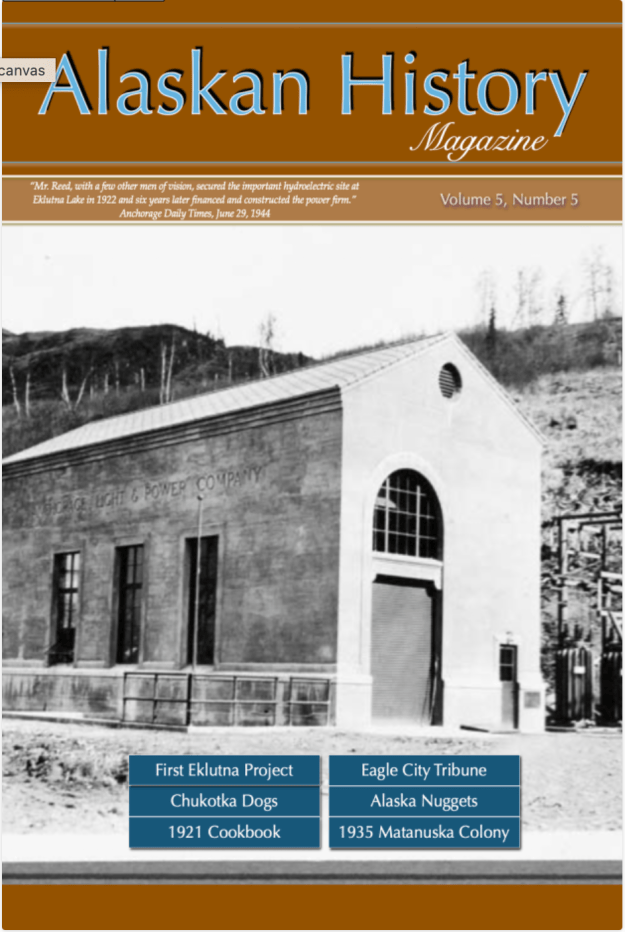
The cover of Volume 5, Number 5 features the first Eklutna Power house. This issue includes the history of the first Eklutna Power Plant, built in the late 1920s, thirty years before today’s Eklutna Hydroelectric Project. But it also tells the story of Anchorage businessman Frank I. Reed, who spearheaded the Eklutna Power Project and whose many other contributions led the Anchorage Daily Times to memorialize him upon his death in 1944: “….Mr. Reed probably had more to do with the advancement of the city of Anchorage than any other individual….”
Also in this issue:
• The history of the Chukotka dogs of Russia, a stout, hardy, bright-eyed and prick-eared type of dog, used for herding, hunting, packing, and pulling sledges over long distances. The article is an except from the book, The Hope ’91 Sled Dog Race: From Nome, Alaska to Anadyr, Russia, by Helen Hegener and Jon Van Zyle.
• A 1921 Cookbook titled “A Collection of Choice Recipes” was compiled by the Anchorage Woman’s Club, which was founded in 1915 by Jane Mears, wife of the man in charge of building the Alaska Railroad. Mrs. Mears and 35 other women used the railroad’s surplus building materials to construct the first schoolhouse in Anchorage.
• The Eagle City Tribune was a weekly newspaper published during the Klondike Gold Rush in Eagle City, Alaska, was started by surveyor Charles Carruthers in 1898. As it turns out, Carruthers was somewhat of a scoundrel and the miners held a meeting….
• Frank B. Camp was a soldier-poet who penned the lines of the popular ballad ‘My Hitch in Hell’ in 1917, for his book, American Soldier Ballads.In 1921 he wrote a book of Alaskan poetry, Alaska Nuggets, and four of his poems are shared in this issue.
• And last, the story of how, in the spring of 1935, the federal government transported 200 midwestern families to Alaska as part of F.D.R.’s New Deal social experiment, the Matanuska Colony Project. This article, an excerpt from a book by Helen Hegener, focuses on how and why the families were selected and transported to Alaska. An excerpt from the article:
“There was, however, an important difference between two groups of individuals involved in promoting and planning the Matanuska settlement. One group, typified by Westbrook and M. D. Snodgrass, manager of the agricultural experiment station in Palmer, believed that Alaska’s environmental and economic constraints would never allow the colonists’ farms to proceed beyond a subsistence level; therefore, they felt that individuals with skills in fields such as carpentry and blacksmithing could pursue small-scale, part-time farming for supplementary income. On the other hand, architect Williams, the media, and some Alaskan officials and boosters claimed that the colonists could develop profitable dairy farms and sell their excess produce to the territory’s future settlers and residents.” –Arnold R. Alanen, emeritus professor in the Department of Landscape Architecture, University of Wisconsin


